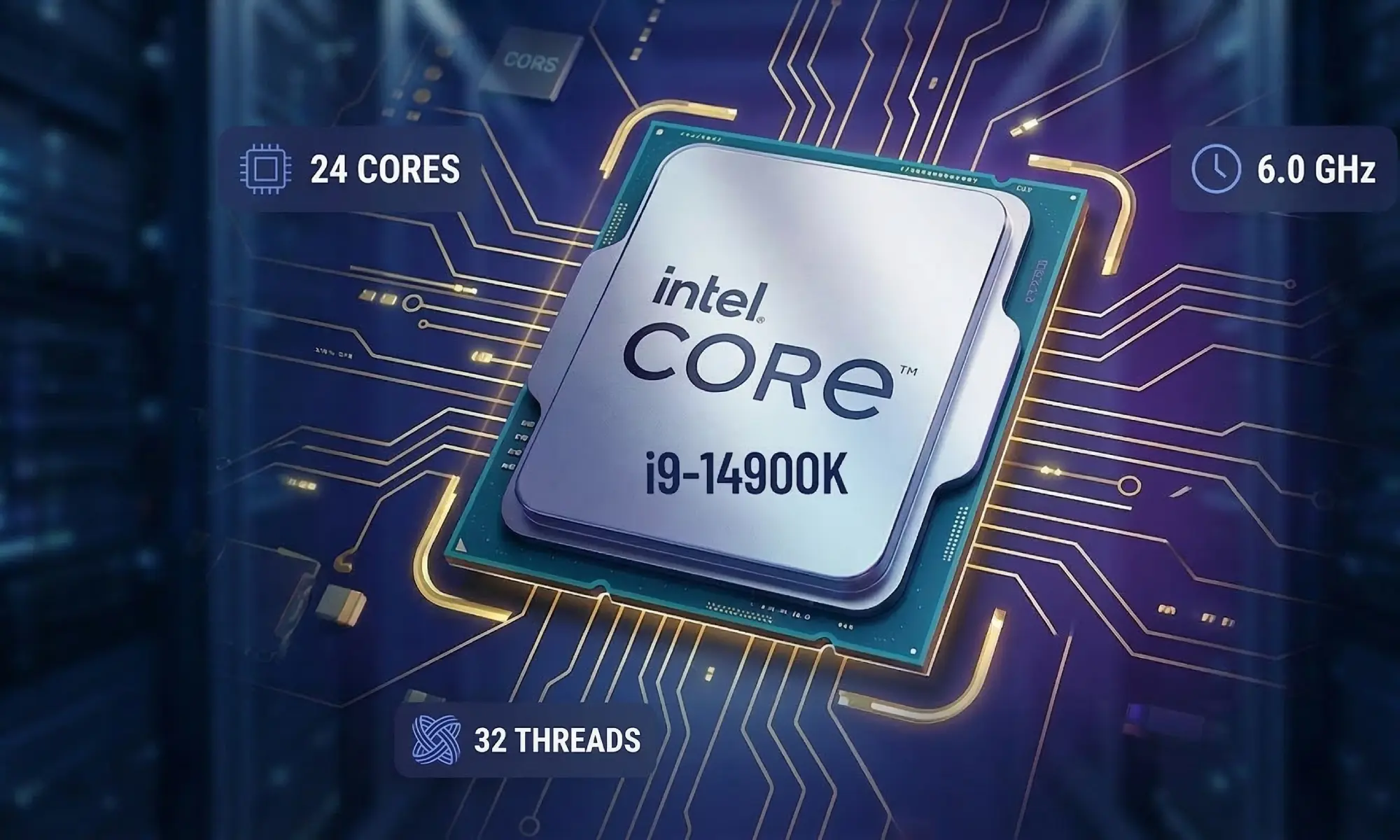
The Intel Core i9-14900K is best suited to dedicated server workloads that benefit from high clock speed, low-latency response, and strong per-core performance. In a properly configured bare metal environment with NVMe storage, enterprise networking, and DDoS protection, it can deliver excellent responsiveness for applications where fast processing time matters more than extreme core density.
Titles such as Minecraft, Rust, CS2, FiveM, and other real-time multiplayer platforms often benefit from high-frequency CPU performance. An i9-14900K dedicated server can be a strong choice for game hosting environments where tick consistency, plugin performance, and fast storage access are priorities. Final capacity depends on the game engine, player count, mods, plugins, RAM allocation, and network setup.
For automation platforms, pricing engines, event-driven services, and trading-related applications, fast single-thread execution can be more valuable than very high core counts. A dedicated i9-14900K bare metal server offers isolated resources and predictable performance for latency-sensitive processing.
E-commerce platforms, APIs, CRM systems, and transactional databases can benefit from the processor’s high-frequency performance when query response time and frontend responsiveness are important. Combined with fast NVMe storage and dedicated bandwidth, the i9-14900K can support responsive business workloads on a single-tenant server.
The Intel Core i9-14900K can also be used for virtualization, containers, CI/CD runners, and development labs. It is typically a better fit for moderate VM density and mixed workloads than for very large-scale virtualization clusters that require higher memory capacity, more PCIe expansion, or significantly higher total core counts.
A high-frequency desktop-class processor that is often selected for dedicated hosting use cases where clock speed, responsiveness, and strong single-thread performance matter.
6.0 GHz
24
32
36 MB
*Benchmark figures should be treated as reference values and may change over time as new test submissions are added.
DDR5 5600 MT/s & DDR4 3200 MT/s
The Intel Core i9-14900K is not a replacement for every Xeon or EPYC deployment, but it can deliver excellent value in environments where clock speed and responsiveness are more important than maximum platform scalability. For many latency-sensitive workloads, it offers a strong balance of performance, fast storage support, and lower platform overhead in a dedicated bare metal setup.
Here are the practical advantages for the right workload:
Applications that depend on strong per-core speed can benefit from the i9-14900K’s high turbo frequency and strong single-thread benchmark profile. This can be valuable for gaming nodes, automation services, API backends, real-time processing, and business applications where response time matters.
Intel UHD Graphics 770 includes Intel Quick Sync Video, which can help with supported media transcoding tasks. Depending on codec, software stack, and workload design, this may reduce the need for a dedicated GPU in some streaming and media workflows.
When paired with fast NVMe SSD storage, dedicated bandwidth, and optional RAID configurations, the i9-14900K can provide a highly responsive hosting platform for high-traffic applications, control panels, game services, and development environments that need fast disk and CPU performance together.
Choosing the right CPU depends on workload type, memory requirements, expansion needs, licensing model, and budget. The Intel Core i9-14900K is often a strong choice for high-frequency, low-latency, and performance-per-core focused hosting. Xeon and EPYC platforms are generally more appropriate for heavier enterprise scalability, higher memory capacity, and larger virtualization density.
| Feature | Intel Core i9-14900K | Intel Xeon | AMD EPYC |
|---|---|---|---|
| Platform Focus | High-frequency dedicated workloads | Enterprise infrastructure | High-density scale-out environments |
| Max Clock Speed | Up to 6.0 GHz | Typically lower than top desktop turbo clocks | Typically lower than top desktop turbo clocks |
| Single-Thread Performance | Strong | Varies by model | Varies by model |
| Multi-Core Scale | Moderate to high | High | Very high |
| Best Fit | Game servers, APIs, trading apps, responsive business workloads | Enterprise databases, virtualization, certified platforms | Cloud, virtualization, analytics, large node density |
| ECC Memory Support | Supported on compatible platforms | Common | Common |
| Scalability | Better for focused single-server performance | Better for enterprise platform features | Better for core-heavy deployment scale |
| Typical Buyer Priority | Speed, responsiveness, cost-conscious performance | Validation, memory, platform longevity | Density, throughput, scale |
The Intel Core i9-14900K is a strong option for workloads that benefit from high clock speed, strong single-thread performance, and dedicated bare metal resources. It is commonly considered for game hosting, automation platforms, media services, responsive databases, and other latency-sensitive applications.
It depends on the workload. The i9-14900K is often attractive for high-frequency, low-latency, and performance-per-core tasks. Xeon and EPYC are usually stronger choices for heavier enterprise memory requirements, higher PCIe expansion, platform certification, and large-scale virtualization density.
Yes. It can run virtualization platforms such as Proxmox, VMware ESXi, and KVM for moderate VM density, development labs, containers, and mixed workloads. For very large virtualization clusters, higher-core server CPUs may be a better fit.
The processor supports ECC on compatible platforms, but ECC availability depends on the motherboard, chipset, BIOS, and memory configuration used in the final server build.
Yes. The Intel Core i9-14900K includes Intel UHD Graphics 770 with Intel Quick Sync Video, which can assist with supported hardware-accelerated media workflows.
Yes. A dedicated bare metal server provides single-tenant hardware resources, direct system control, and consistent performance without shared hypervisor overhead from public cloud neighbors.
Yes. Dedicated server deployments are commonly paired with NVMe SSD storage, optional RAID configurations for performance or redundancy, and always-on DDoS protection depending on the server plan and infrastructure design.
The i9-14900K can be a strong fit for applications that need responsive compute performance together with high-speed networking, such as game platforms, delivery nodes, automation systems, API services, and streaming-related workloads.
🔒 No hidden fees. Transparent monthly and annual billing.