Loading Products...
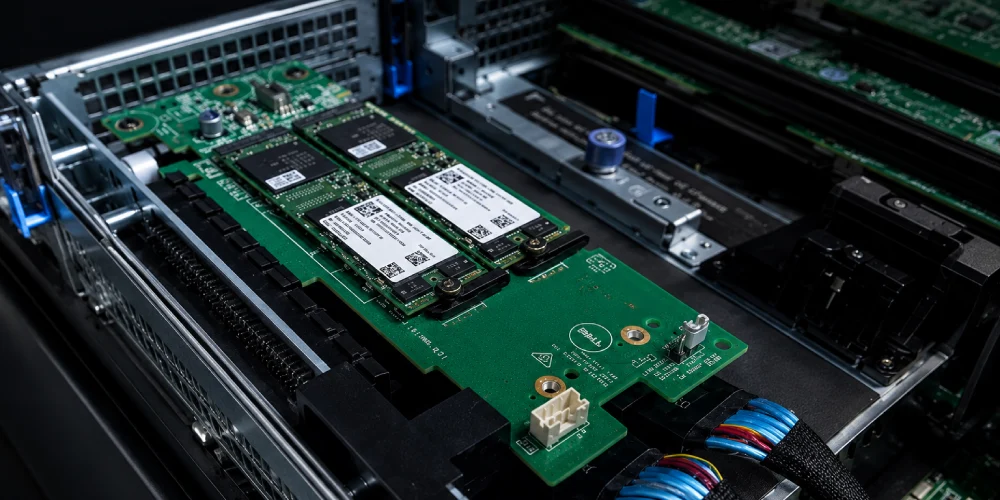
At MIG servers, we engineered our infrastructure to eliminate the most critical performance bottleneck in modern computing: disk I/O. While traditional SATA SSDs rely on the legacy AHCI interface designed for spinning hard drives, our all-flash NVMe servers connect storage directly to the CPU via the PCI Express (PCIe) bus. This parallel data transmission architecture delivers the raw speed and low latency required for enterprise databases, AI processing, and high-concurrency applications.
Traditional SATA SSDs use a single command queue limited to 32 commands, capping transfer speeds at roughly 600 MB/s.
Our NVMe SSD for servers utilizes the PCIe Gen4/Gen5 interface to support up to 64,000 parallel command queues. By removing the legacy SATA bus, NVMe servers process data across multiple parallel lanes simultaneously without hardware queuing delays.
Standard solid-state drives choke under heavy simultaneous read/write requests, causing database query locking and server lag.
Our dedicated servers with NVMe storage deliver up to 14x higher throughput than legacy SSDs. With sequential read/write speeds exceeding 7,000 MB/s and routine performance above 500,000 IOPS, your resource-intensive workloads run without storage throttle.
Hardware RAID controllers and SATA cables introduce physical latency, slowing down real-time data access during traffic spikes.
By deploying direct M.2 and U.2 NVMe storage servers, we reduce storage latency to under 20 microseconds. This instant query execution ensures zero bottle-necking for high-traffic e-commerce stores, intensive financial databases, and real-time multiplayer game servers.
When hardware resources are stretched to their limits, storage disk latency is almost always the first component to cause system degradation. While high-end CPUs and massive RAM arrays handle computing, any delay in data retrieval, known as high I/O wait time, will choke the entire server infrastructure. High-performance NVMe dedicated servers are engineered to bypass legacy storage hardware limitations, delivering sub-20 microsecond latency and 500,000+ IOPS across nine critical enterprise environments where traditional storage architectures fail.
The Challenge: Large database engines handling thousands of simultaneous read/write requests quickly exhaust the single-queue command limit of legacy SATA drives. This limitation causes query queuing, database table locking, and elevated I/O wait times during peak transactional loads.
Why NVMe is Needed: Direct PCIe parallel architecture processes up to 64,000 command queues simultaneously. This massive concurrency allows relational and NoSQL databases to execute complex transactions with sub-20 microsecond latency, eliminating storage throttle entirely.
Key Entities: MySQL, PostgreSQL, MongoDB, MariaDB, Microsoft SQL Server, Redis, Elasticsearch.
The Challenge: E-commerce platforms and dynamic content management systems require instant database read access to generate product pages and process checkouts during traffic surges or flash sales. When traditional storage struggles with concurrent requests, Time to First Byte (TTFB) spikes, leading to cart abandonment.
Why NVMe is Needed: Deploying dedicated servers with NVMe storage ensures uninterrupted data retrieval and ultra-fast page rendering. Removing disk I/O latency protects conversion rates and prevents backend crashes regardless of concurrent visitor volume.
Key Entities: Magento (Adobe Commerce), WooCommerce, Shopify Plus (Headless Backends), BigCommerce, WordPress VIP.
The Challenge: Training complex machine learning models and processing massive data pipelines require streaming terabytes of unstructured data to compute clusters continuously. Slow storage drives cause "GPU starving," a hardware bottleneck where expensive processors sit idle waiting for data staging.
Why NVMe is Needed: Utilizing PCIe Gen4 and Gen5 interfaces, NVMe storage servers provide sequential read speeds exceeding 7,000 MB/s. This continuous, high-bandwidth throughput ensures uninterrupted data ingestion for algorithmic training and predictive modeling.
Key Entities: TensorFlow, PyTorch, Apache Spark, Hadoop, Apache Kafka, Jupyter Notebooks.
The Challenge: Hosting dense virtualization clusters or containerized microservices on a single host often leads to "noisy neighbor" I/O contention, where one virtual machine's disk usage degrades the entire system. Similarly, real-time gaming networks suffer from micro-stutters when map data fails to load instantly.
Why NVMe is Needed: Bare-metal NVMe servers provide massive IOPS bandwidth to cleanly isolate virtual drives and run dozens of independent environments simultaneously without performance degradation, while guaranteeing rock-solid server tickrates for multiplayer gaming networks.
Key Entities: Proxmox VE, VMware ESXi, KVM, Kubernetes, Docker, FiveM, Rust, CS2, Minecraft Enterprise Clusters.
The Challenge: While core high-frequency trading (HFT) order-matching executes in RAM and CPU L3 cache, financial platforms face severe storage bottlenecks when processing continuous trade logging, risk analytics, compliance audits, and real-time transaction ledgers.
Why NVMe is Needed: NVMe storage provides the high-speed data logging, instant database query execution, and rapid ledger synchronization required for payment gateways, financial risk engines, and transactional databases without controller bottlenecks.
Key Entities: MetaTrader 5 (MT5), FIX Protocol loggers, Financial audit databases, PCI-DSS compliant ledgers, risk analytics engines, blockchain validation nodes.
The Challenge: Media delivery networks, OTT streaming platforms, and broadcast production environments must simultaneously ingest, encode, transcode, and deliver high-bitrate video streams to thousands of concurrent viewers without frame dropping or buffer under-runs.
Why NVMe is Needed: With sequential read/write speeds over 7,000 MB/s, NVMe SSD dedicated servers hosting high-demand media pipelines allow continuous multi-stream video transcoding and instant chunk delivery over Content Delivery Networks (CDNs) without disk read errors.
Key Entities: FFmpeg, Wowza Streaming Engine, Plex Media Server, NGINX RTMP, H.265/AV1 video pipelines.
The Challenge: Programmatic advertising networks and Real-Time Bidding (RTB) platforms must process millions of simultaneous ad auction requests per second, evaluate user profile data, and serve the winning ad impression in under 50 milliseconds.
Why NVMe is Needed: Massive IOPS capacity allows servers with NVMe technology to instantly query user profile data, run real-time bidding algorithms, and log massive impression datasets simultaneously on high-speed NoSQL databases with zero latency.
Key Entities: OpenRTB protocols, Apache Druid, ClickHouse, Aerospike, MongoDB.
The Challenge: Research institutions and engineering firms running genomic sequencing, weather forecasting models, or molecular dynamics simulations process terabytes of complex mathematical data continuously. Slow storage throughput significantly increases computational runtimes.
Why NVMe is Needed: Eliminates data staging bottlenecks, allowing multi-core EPYC and Xeon processors on Supermicro NVMe servers to compute scientific models at maximum speed without waiting for hard drive reads.
Key Entities: MATLAB, BLAST (Bioinformatics), WRF (Weather Research and Forecasting), OpenFOAM, scientific computing clusters.
The Challenge: Restoring a multi-terabyte database from traditional SATA backup drives during a system failure or ransomware attack can take several hours, resulting in catastrophic business downtime and unacceptable Recovery Time Objectives (RTO).
Why NVMe is Needed: All-flash NVMe servers allow system administrators to restore massive enterprise snapshots and execute full database failovers in minutes rather than hours, guaranteeing near-instant recovery for enterprise backup pipelines.
Key Entities: Veeam, Bacula, Percona XtraBackup, Continuous Data Protection (CDP) pipelines, automated failover nodes.
No Sharing. Zero Overhead: Your workloads run on 100% unshared bare-metal hardware. With no hypervisor lag or noisy neighbors, your applications utilize the full processing power, memory bandwidth, and I/O speed of the physical server.
Enterprise Reliability: Mission-critical databases and high-traffic platforms require continuous 24/7/365 availability. Our tier-rated data centers feature redundant N+1 power and cooling infrastructure, backed by a strict 99.99% uptime guarantee.
Unthrottled Data Transfer: Built for heavy traffic and media streaming, our dedicated servers with NVMe storage connect to non-blocking ports scaling from 1Gbps up to 100Gbps. Enjoy ultra-low routing latency over Tier-1 global networks.
Always-On Inline Mitigation: Keep your business online during severe cyber attacks. Our enterprise filtering hardware automatically detects and scrubs Layer 3/4 and Layer 7 volumetric DDoS attacks up to 250Gbps in microseconds without slowing down your traffic.
Scalable All-Flash Power: Powered by enterprise Intel Xeon, AMD EPYC/Ryzen CPUs, and NVIDIA GPUs. As your data footprint scales, you can seamlessly expand your all-flash NVMe storage capacity from 100GB to over 100TB, alongside RAM and CPU core upgrades—without requiring any platform migration.
Your Stack, Your Choice: Retain full root/administrator control over your hosting environment. Deploy popular Linux distributions, Windows Server, or install Proxmox VE for virtualization. We also support custom ISO uploads for specialized deployment stacks.
Effortless Server Management: Manage your server easily with instant installation and automated licensing for cPanel/WHM, Plesk, and DirectAdmin. Our bare-metal environments also fully support custom control panels and proprietary management API integrations.
Zero Data Loss & Minimal Downtime: Moving to our bare-metal NVMe servers is seamless. Our engineering team handles free white-glove migrations for standard control panels (cPanel/Plesk). For complex custom databases, we offer tailored migration planning.
Flexible Enterprise Redundancy: Configure your NVMe storage servers for maximum data protection or raw read/write throughput. By utilizing high-performance software RAID (Linux mdadm / ZFS) and Intel VROC, we completely avoid legacy hardware controller bottlenecks—allowing seamless deployment across RAID 0, 1, 5, and 10 arrays while unlocking 100% of your NVMe I/O speed.
While SATA solid-state drives were once the industry standard, their legacy AHCI bus architecture creates a significant bottleneck for modern computing. Our dedicated servers with NVMe storage bypass this limitation entirely, connecting directly to the PCIe Gen4/Gen5 bus to deliver up to 12x faster throughput and 10x higher I/O concurrency.
Higher IOPS and sub-20 microsecond latency mean your relational databases execute complex queries instantly without table locking. Whether you are running high-traffic e-commerce stores, virtualization clusters, or big data pipelines, our high-performance NVMe dedicated servers ensure CPU and RAM resources never sit idle waiting for disk reads.
SATA SSDs are capped at roughly 600 MB/s by the legacy AHCI interface designed for spinning disks. Our all-flash NVMe servers connect directly to the PCIe Gen4/Gen5 bus, delivering over 7,000 MB/s sequential read speeds and 500,000+ IOPS to eliminate database query queuing entirely.
No. We deploy data-center-grade enterprise NVMe storage servers equipped with high Drive Writes Per Day (DWPD) endurance ratings and Power-Loss Protection (PLP). They are engineered to sustain continuous, heavy 24/7/365 I/O workloads like AI training, high-frequency financial logging, and intensive database transactions without performance degradation.
We support both software RAID (mdadm / ZFS) and enterprise software RAID options. For dedicated servers with NVMe storage, we strongly recommend ZFS mirroring (RAID 1) to RAID 10 to ensure maximum data redundancy without creating storage controller bottlenecks.
Yes. You receive 100% bare-metal root and administrator access. System administrators can customize Linux I/O schedulers, tweak kernel parameters, install custom drivers, or deploy hypervisors like Proxmox VE to extract maximum performance from your high-performance NVMe dedicated servers.
Standard bare-metal server deployment takes between 24 to 72 hours after order verification. Because we provision 100% dedicated, unshared physical hardware, followed by custom OS installation and thorough hardware stress-testing, we ensure your server is fully stable and optimized before handover.
Yes. Our bare-metal NVMe servers are built for seamless scalability. As your traffic or database grows, our engineering team can schedule a brief, planned maintenance window to add extra NVMe drives, upgrade ECC RAM, or scale network ports up to 100Gbps without data loss or platform migration.
Yes, real-time hardware customization is available directly on our order page for all upgrade-capable server models. When configuring your high-performance NVMe dedicated server, you can easily select additional ECC RAM, extra NVMe storage arrays, and higher bandwidth allocations for supported customizable plans prior to checkout.
Your infrastructure deserves raw bare-metal speed. Don't let legacy SATA drives cap your concurrency or cause database locking. Deploy a high-performance NVMe dedicated server today to experience sub-20 microsecond latency, 500,000+ IOPS, and 100% unshared resources, provisioned and stress-tested within 24 to 72 hours.
Need a help? Talk to a Server Architect
