MIG servers July 14, 2026
Let’s be honest. When you are provisioning a dedicated server, it is easy to spend hours debating CPU cores, NVMe storage, and bandwidth limits. But if you get the physical location wrong, none of that hardware matters. Distance creates latency, and in the hosting world, latency kills performance.
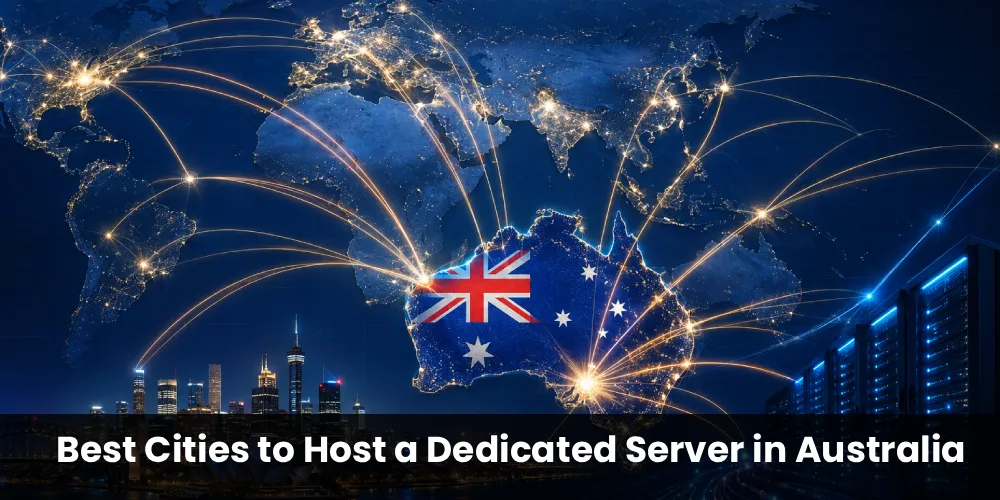
If your primary user base is in Oceania or the broader Asia-Pacific (APAC) region, hosting your dedicated server in Australia is the most logical move. You get ultra-low ping times across the continent, rock-solid power grid reliability, and strict compliance with the Australian Privacy Principles (APP) for data sovereignty.
But Australia is a massive country, roughly the same landmass as the contiguous United States. Simply telling your hosting provider "I want an Australian server" isn't specific enough. The network routing in Sydney is vastly different from the fiber paths in Perth or Brisbane.
So, where exactly should you deploy your infrastructure?
To answer that, you need to look beyond just the hardware. In this guide, we break down the best Australian cities for bare metal and dedicated hosting. We have categorized them into Tier 1 hubs and Tier 2 strategic locations, helping you match the exact city to your specific network requirements, budget, and target audience.
Table of Contents
What Makes a City "Tier 1" or "Tier 2" for Hosting?
When we evaluate Australian cities for deploying dedicated servers, we aren't just looking at local population sizes or real estate costs. We are looking at hard network data and physical infrastructure.
Before we rank the specific cities, here is the exact criteria we use to separate the primary hubs from the strategic edge locations:
- Subsea Cable Landings:The internet runs on physical underwater cables. A city that serves as a direct landing point for major international subsea fiber gets first access to global networks. This cuts out unnecessary routing hops and drastically drops international ping times.
- Network Density and Peering: How many independent network carriers and Internet Service Providers (ISPs) operate within the local data centers? Cities that host major Internet Exchanges (like IX Australia) allow for direct peering. This means your server can exchange traffic directly with local networks, offering a much smoother experience for domestic users.
- Disaster Recovery (DR) Viability: Enterprise environments rarely put all their eggs in one basket. If a business runs its primary production server in one city, they need a secondary location for failover. We look at the dark fiber backbone connecting these cities to ensure data can sync instantly between a primary and backup site.
- Power and Facility Redundancy: High-performance bare metal servers draw a lot of power and generate significant heat. A top-tier hosting city must have a highly stable local power grid and facilities built with N+1 or 2N redundancy for cooling and power.
Based on these technical realities, the Australian hosting map clearly splits into two categories: the major network hubs (Tier 1) and the regional edge powerhouses (Tier 2).
Tier 1 Cities: The Heavyweight Hubs
When we talk about Tier 1 hosting in Australia, we are talking about massive network density and global connectivity. These are the cities where the biggest carriers meet, peer, and exchange traffic. If your application cannot tolerate network bottlenecks, your infrastructure belongs here.
1. Sydney: The Global Connectivity Gateway
Sydney is the undisputed center of Australia's internet infrastructure. Why? Because physical geography and history dictate it. The vast majority of international submarine cables—including the Southern Cross, Hawaiki, and INDIGO-Central cables—land directly on the shores of New South Wales.
When you provision a dedicated server in a Sydney data center, you are essentially plugging directly into the country's main internet artery. Traffic doesn't need to travel across the continent before heading overseas; it hits the subsea fiber almost immediately.
- The Technical Edge:Maximum global bandwidth and the highest concentration of local Internet Exchanges (IXs).
- Best Suited For: High-frequency financial trading platforms, global SaaS applications, and enterprise networks that demand the absolute lowest latency to the US West Coast and the broader APAC region.
2. Melbourne: The Domestic Powerhouse & DR Hub
If Sydney is the global gateway, Melbourne is the domestic engine. As Australia's second-largest technology hub, Melbourne boasts a massive local fiber footprint and enterprise-grade data center facilities that rival anything found in Sydney.
Strategically, Melbourne’s biggest advantage is actually its relationship with Sydney. The physical distance between the two cities is roughly 800 kilometers, and they are connected by multiple high-capacity, redundant dark fiber routes. This makes Melbourne the perfect Disaster Recovery (DR) location. If you run your primary bare metal servers in Sydney, spinning up a hot-standby server in Melbourne guarantees geographic redundancy. You get a completely separate power grid and weather zone, with a negligible inter-city latency of just 10 to 12 milliseconds.
- The Technical Edge: Excellent domestic routing and cost-effective premium infrastructure.
- Best Suited For: Australian-focused e-commerce sites, local tech startups, and enterprises needing a bulletproof active-passive failover setup.
Tier 2 Cities: The Strategic Edges
Do not let the "Tier 2" label fool you. In the network engineering world, Tier 2 simply means a location is highly specialized rather than a general-purpose global hub. If your user base aligns with these specific geographic pockets, hosting here can actually outperform Sydney.
3. Perth: The Southeast Asian Connector
Look at a map, and you will see why Perth is completely unique. It is physically closer to Singapore and Jakarta than it is to Sydney. For years, Perth has been the quiet powerhouse for companies needing low latency to Southeast Asia without paying Singapore data center premiums.
Thanks to direct submarine routes like the INDIGO-West and the Oman Australia Cable (OAC), a bare metal server in Perth can hit Singapore in under 50 milliseconds. Furthermore, with the massive 400Tb/s SMAP (Sydney-Melbourne-Adelaide-Perth) transcontinental hypercable reaching Ready for Service (RFS) status in 2026, Perth's domestic isolation is officially a thing of the past.
- The Technical Edge: Direct oceanic routing to Asia combined with next-gen transcontinental domestic fiber.
- Best Suited For: Multiplayer gaming servers, mining tech platforms in Western Australia, and businesses bridging the Australian and Southeast Asian markets.
4. Brisbane: The Northern Powerhouse
Brisbane (and the nearby Sunshine Coast) is rapidly transforming. Historically, Queensland businesses just hosted their servers in Sydney and accepted the slight latency penalty. That is no longer necessary.
With the Japan-Guam-Australia South (JGA-S) network already active, and Google’s highly anticipated Tabua subsea cable—connecting Australia to Fiji and the United States—coming online by 2026, the region is becoming a legitimate international data hub. Even for domestic routing, Brisbane provides a crisp ~12ms round-trip time to Sydney, making it an excellent cost-effective alternative.
- The Technical Edge: Expanding direct international cable landings and lower operational costs than Sydney.
- Best Suited For: Regional Queensland enterprises, scalable backup environments, and companies looking for a highly capable alternative outside the traditional East Coast corridor.
5. Adelaide: The Cost-Effective Central Hub
Geographically sitting right in the middle of the Australian coastline, Adelaide is often overlooked, but it is currently having a renaissance. It offers a literal geographic "sweet spot" bridging the East and West coasts.
The real game-changer for Adelaide is its integration into the new 2026 SMAP transcontinental cable route. This dramatically reduces the latency between Adelaide, Perth, and Melbourne. With massive local government investments in smart infrastructure and tech parks, data center space here is modern and highly affordable.
- The Technical Edge: Perfectly centralized geography and deeply competitive bare metal pricing.
- Best Suited For: AI research workloads, mass data storage, and budget-conscious enterprises that still demand highly secure, onshore hosting.
Quick Comparison: Which City is Right for You?
If you want a fast, high-level overview before diving into the specific latency numbers, here is how the top Australian data center locations stack up against each other:
| City | Best For | Asia Latency | Domestic Network | Recommendation |
|---|---|---|---|---|
| Sydney | Global Hosting & Financial Apps | Excellent | Excellent |
|
| Melbourne | Disaster Recovery & Startups | Good | Excellent |
|
| Perth | Asia-Targeted Traffic & Gaming | Outstanding | Good |
|
| Brisbane | Queensland/Regional Traffic | Good | Excellent |
|
| Adelaide | Budget & Centralized Storage | Good | Good |
|
Conclusion
Choosing the right Australian city for your dedicated server ultimately comes down to knowing exactly where your users are and what your application demands.
If you are running a high-frequency trading platform or a massive global SaaS application, do not overthink it—Sydney is where you need to be. If you are building a resilient network and need an active-passive setup, pair Sydney with Melbourne.
However, if your traffic heavily targets Southeast Asia, deploying in Perth will shave off critical milliseconds. And if you are simply looking for a robust, cost-effective hub for domestic users, both Brisbane and Adelaide offer incredible bare metal value without sacrificing domestic performance.
Your server's physical location defines your network's ceiling. Choose the city that aligns with your traffic map, and the hardware will take care of the rest.
 Recent Topics for you