MIG servers September 24, 2026
Modern AI infrastructure has rapidly transitioned from static, monolithic training and inference clusters to highly dynamic Agentic AI pipelines. Unlike traditional models that rely on predictable compute cycles, agentic systems process single requests through complex, multi-stage execution chains encompassing data retrieval, external tool calls, and real-time code execution.
This architectural shift creates a highly variable compute footprint. An agentic workflow is inherently shape-shifting, demanding fluctuating computational capacities and dynamic resource allocation across different server nodes during a single execution loop.
Consequently, rigid hardware deployments are no longer viable for modern data centers. Supporting autonomous AI agents requires strict architectural flexibility at every layer of the technology stack. For enterprise environments, this necessitates highly adaptable server CPUs capable of processing diverse, shifting computational profiles without introducing latency or performance bottlenecks into the agentic pipeline.
The Converged Compute Demands of Agentic Workflows
Enterprise environments have historically managed varying system profiles for distinct workloads, provisioning separate infrastructure for databases, virtualization, real-time analytics, web services, and high-performance technical computing. Agentic AI disrupts this traditional model by converging multiple computational profiles into a single, cohesive execution pipeline.
Instead of isolating tasks, an AI agent might query a vector database, execute analytical Python code, and render a web service response within milliseconds. To support this, modern server architecture must natively handle diverse, concurrent workloads without the latency overhead of routing tasks across fragmented, specialized clusters.
Enter the 6th Gen AMD EPYC™ 9006 "Venice" Architecture
Addressing the critical need for multi-workload flexibility, AMD’s newly evaluated 6th Gen AMD EPYC™ 9006 "Venice" server CPUs deliver a comprehensive solution. Rather than relying on narrow optimizations for specific tasks, the Venice architecture is engineered to execute across general-purpose, enterprise, cloud-native, AI, and high-performance computing (HPC) workloads with exceptional efficiency.
The AMD EPYC 9006 series represents a highly scalable processor portfolio built upon a common software foundation. The lineup spans from lightweight 8-core deployments tailored for edge environments up to massive 256-core flagship processors designed for rack-scale AI host nodes.
This tiered architectural approach ensures that each specific role within an agentic pipeline can leverage the exact processor profile it requires, completely eliminating the need to maintain separate operating environments. Currently in production, the "Venice" CPUs are actively being integrated into major OEM platforms, with leading cloud service providers slated for deployment later this year.
Performance Benchmarks: EPYC 9996 vs. Competing Architectures
To quantify this architectural flexibility, extensive testing evaluates the flagship AMD EPYC™ 9996 server CPU against major market alternatives across a highly diverse set of AI, enterprise, and technical workloads.
The data below reveals significant throughput and per-core performance advantages:
- SPECrate® 2026 Integer Performance: The EPYC 9996 delivers 1.2x higher per-core performance and an impressive 2.24x platform-level performance advantage over an Nvidia Vera-based platform.
- Enterprise & Cloud-Native Workloads: Across highly concurrent applications—including server-side Java, OpenSSL cryptography, MongoDB, Redis, NGINX web serving, and transaction processing—AMD testing reports substantial gains ranging from 2.4x to 3.7x.
- High-Performance Computing (HPC): When benchmarked against the Intel® Xeon® 6980P processor in complex compute-heavy tasks like molecular dynamics, materials modeling, and weather forecasting, the EPYC 9996 maintains a 1.8x to 3.13x performance lead.
Crucial Data Center Metric: In a modeled 100-kilowatt rack configuration, the AMD EPYC 9996 CPU is estimated to deliver 3.4 times the total throughput of a comparable Nvidia Vera-based platform, drastically improving power-to-performance ratios for enterprise data centers.
Balancing Per-Core Performance with Massive Core Density
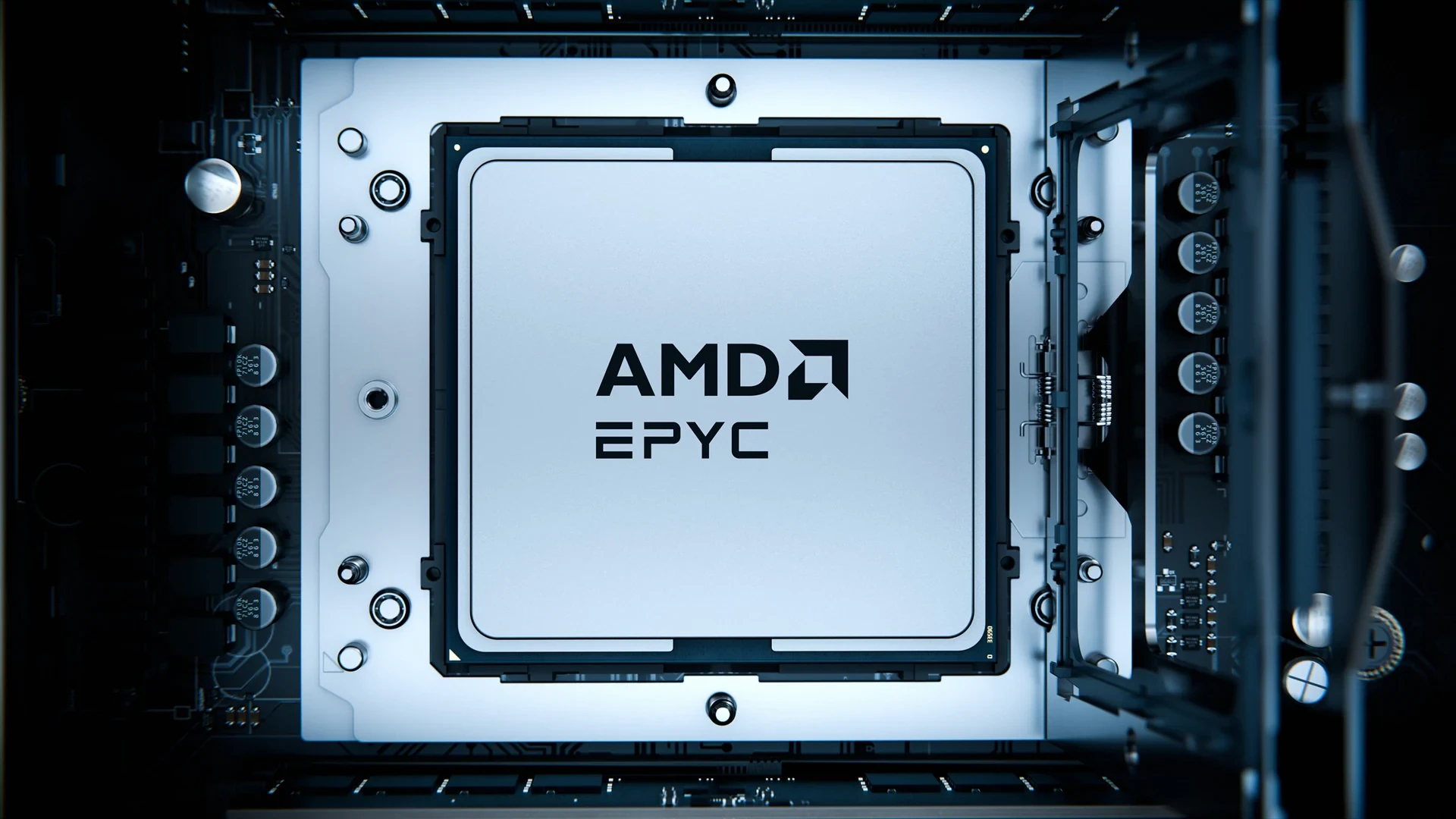
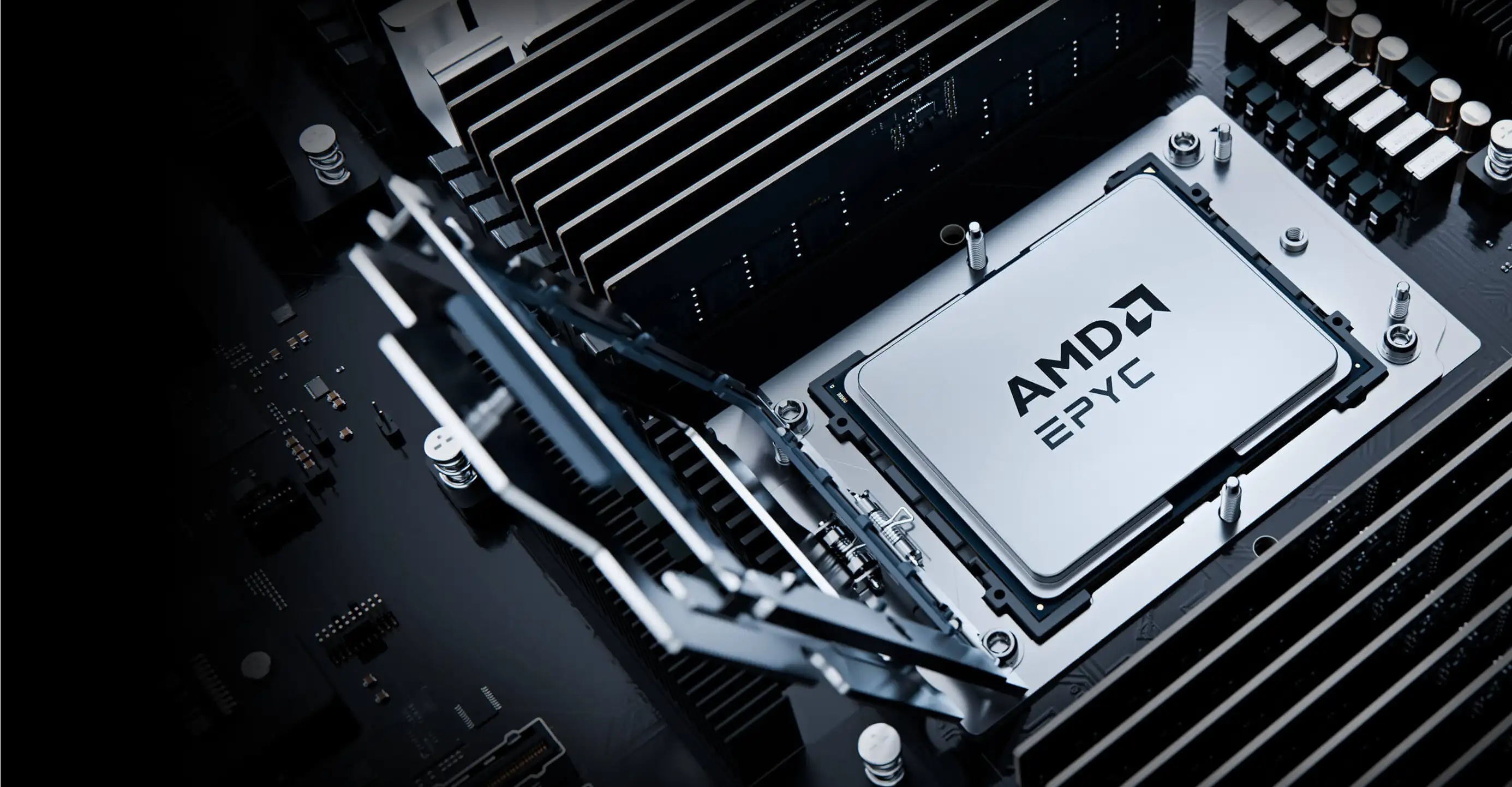
The visual architecture of the AMD EPYC processor illustrates how this performance is physically achieved on the server motherboard. Notice the dense thermal and memory interface layout surrounding the core silicon—this physical design is what enables the chip to balance two historically competing server requirements: latency and concurrency.
In an agentic AI pipeline, strong loaded per-core performance is mandatory for accelerating latency-sensitive sequential work, such as rapid database querying or executing complex logical inferences.
Simultaneously, massive core density is required to support the extreme concurrency of agentic tools, allowing hundreds of parallel API calls and vector searches to run without bottlenecking rack-level throughput. By utilizing a scalable processor portfolio, enterprise customers can precisely optimize for both latency and concurrency across their server fleet without imposing compromised hardware constraints on specific stages of their AI workflows.
Future-Proofing Your Infrastructure for Varied Workloads
The trajectory of Agentic AI guarantees one absolute certainty: workloads will only continue to diversify. As AI agents gain the ability to interact with more complex external toolchains, handle multimodal data streams, and execute multi-step logic autonomously, the computational demands placed on servers will become increasingly unpredictable.
The strategic answer to a highly varied software workload has never been rigid, single-purpose hardware. Future-proofing enterprise AI infrastructure requires deploying a compute foundation where flexibility is natively built into the silicon. By leveraging adaptable, high-density architectures like the AMD EPYC 9006 series, organizations can confidently scale their data centers today, knowing their server nodes possess the exact shape and power required for whatever AI workflows emerge tomorrow.
Related Resources
Looking to build, scale, or upgrade your enterprise AI infrastructure with the latest processor architecture? At MIG servers, we provide high-performance, bare-metal infrastructure tailored specifically for complex, compute-heavy workflows. Explore our range of dedicated AMD EPYC Servers to find the perfect hardware configuration to power your Agentic AI stack securely and efficiently.
 Recent Topics for you