MIG servers September 01, 2026
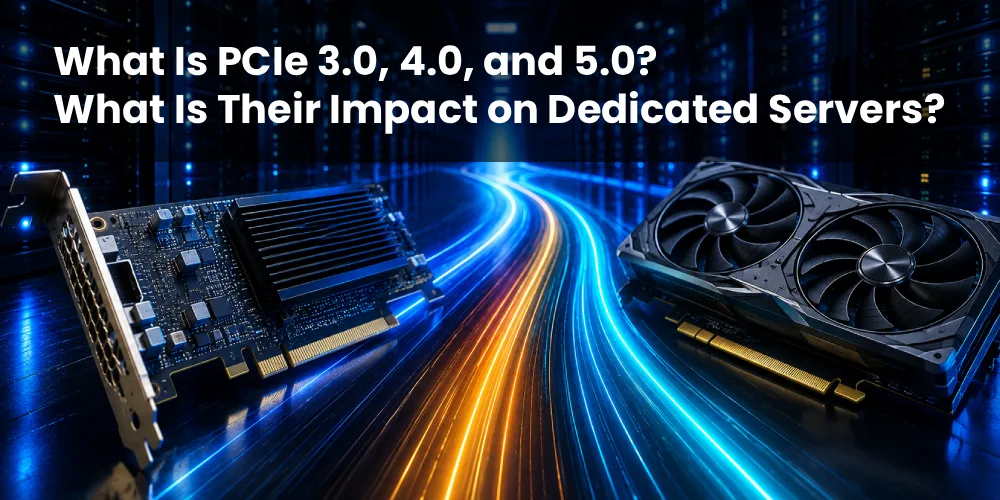
Modern dedicated servers require rapid communication between the central processing unit (CPU) and high-speed hardware components. Peripheral Component Interconnect Express (PCIe) serves as the primary high-speed interconnect used to facilitate this data transfer. When evaluating server hardware, the specific PCIe generation directly affects the maximum link data rate available to the system.
Currently, PCIe 3.0, 4.0, and 5.0 are the most relevant generations when provisioning NVMe storage, GPUs, network adapters, and other expansion devices. However, a newer generation does not automatically guarantee a proportional increase in real-world application speed. Understanding the differences between PCIe 3.0, 4.0, and 5.0 is essential to ensure that your PCIe dedicated servers are appropriately balanced for your specific workload requirements without over-provisioning hardware.
What Is PCIe?
PCIe stands for Peripheral Component Interconnect Express. It is a high-speed interface that acts as the primary interconnect between a server’s system platform (the CPU and motherboard) and compatible expansion devices.
In dedicated servers, PCIe is essential for connecting:
- NVMe SSDs
- High-speed network adapters
- GPUs and hardware accelerators
- RAID and storage controllers
- Other PCIe expansion devices
To understand how it functions, think of PCIe as a high-speed highway connecting the server's CPU to its expansion devices. The PCIe generation determines how fast data can transfer on each lane, while the number of lanes determines the total width of that connection.
PCIe links can be configured with different lane widths, commonly denoted as x1, x2, x4, x8, and x16. PCI-SIG, the organization that defines these standards, documents these specific link widths and their corresponding signaling rates. Together, the generation and the lane width dictate the maximum theoretical data transfer capacity for any connected device.
PCIe 3.0 vs PCIe 4.0 vs PCIe 5.0
When evaluating dedicated server hardware, the PCIe generation dictates the data throughput ceiling between the processor and connected peripherals. As the standard has evolved, PCI-SIG has consistently doubled the signaling rate with each successive iteration.
| PCIe Generation | Signaling Rate | Approx. x16 Bandwidth Per Direction* |
|---|---|---|
| PCIe 3.0 | 8 GT/s | ~16 GB/s |
| PCIe 4.0 | 16 GT/s | ~32 GB/s |
| PCIe 5.0 | 32 GT/s | ~64 GB/s |
*Note: PCI-SIG describes PCIe 5.0 x16 as delivering 128 GB/s aggregate raw bandwidth across both directions, which is equivalent to roughly 64 GB/s per direction. Similarly, PCIe 4.0 provides roughly 32 GB/s per direction, and PCIe 3.0 yields roughly 16 GB/s per direction.
PCIe 3.0
Operating at a signaling rate of 8 GT/s, PCIe 3.0 remains highly capable and is still suitable for many conventional server workloads. It is commonly found in older server platforms and devices where maximum interface bandwidth is not the primary performance bottleneck.
PCIe 4.0
Delivering 16 GT/s, PCIe 4.0 precisely doubles the signaling rate compared with PCIe 3.0. This expanded throughput is highly useful for higher-performance NVMe storage drives, modern network adapters, and other bandwidth-intensive devices that require more capacity than older platforms provide.
PCIe 5.0
Reaching 32 GT/s, PCIe 5.0 doubles the signaling rate compared with PCIe 4.0. This generation is particularly relevant for enterprise-grade high-performance storage, hardware accelerators, and demanding high-bandwidth server workloads.
PCI-SIG officially lists 8, 16, and 32 GT/s for PCIe 3.0, 4.0, and 5.0 respectively, mapping a clear progression in standard server interconnect capabilities.
Understanding PCIe Bandwidth and Lanes
A frequent misconception when provisioning server hardware is equating the PCIe generation with the overall connection capacity. It is critical to understand that PCIe Generation ≠ PCIe Lane Count. For example, a PCIe 4.0 x4, a PCIe 4.0 x8, and a PCIe 4.0 x16 interface are not the same thing, despite sharing the exact same underlying standard.
The PCIe generation determines the maximum signaling rate available per lane. In contrast, the lane count establishes the total physical width of the data path. A higher generation yields more bandwidth per lane, while more lanes increase the total aggregate link width.
Consider a practical example: a PCIe 5.0 x4 connection and a PCIe 5.0 x16 connection operate on the exact same generation. However, they possess significantly different aggregate bandwidths simply because they utilize different numbers of lanes.
Furthermore, when evaluating PCIe bandwidth, it is important to note that theoretical limits differ from actual real-world application speeds. Actual usable throughput is frequently lower than the mathematical maximum due to protocol overhead, device controller efficiency, and specific motherboard or platform limitations.
How Does PCIe Affect Dedicated Server Performance?
The PCIe interface plays a critical role in overall dedicated server performance by defining the communication speed between the core platform and essential peripherals. Its impact is most visible across four key areas:
1. Storage Performance
PCIe directly dictates the interface limits for NVMe SSDs, making it a primary factor for I/O-intensive data and storage workloads.
2. Network Connectivity
High-speed network adapters rely on PCIe to communicate with the server platform. This is especially relevant for environments requiring 1Gbps, 10Gbps, 20Gbps, 40Gbps, or 100Gbps networking. However, the specific PCIe generation required depends entirely on the individual network interface card (NIC) and the server's platform architecture.
3. GPU and Accelerator Workloads
High-performance computing devices, including GPUs and specialized accelerators, can require substantial PCIe bandwidth depending heavily on the specific computational workload.
4. RAID and Storage Controllers
Dedicated hardware used for managing complex enterprise storage arrays also utilizes PCIe interfaces to ensure rapid data transit to the processor.
Crucially, PCIe is only one part of overall server performance. A newer PCIe standard does not automatically make a dedicated server twice as fast. True hardware performance depends on the entire ecosystem: the CPU, RAM, actual storage device limits, network adapter, motherboard platform, PCIe lane allocation, and the specific application workload all matter.
PCIe and NVMe SSDs in Dedicated Servers
Non-Volatile Memory Express (NVMe) SSDs bypass legacy storage protocols by utilizing the PCIe interface to communicate directly with the server’s CPU. Because of this direct, low-latency connection, total PCIe bandwidth becomes an important factor when designing storage architectures for an NVMe dedicated server.
When evaluating server hardware, you will typically encounter PCIe 3.0 NVMe, PCIe 4.0 NVMe, and PCIe 5.0 NVMe drive options. Moving to a newer PCIe generation provides more interface bandwidth, increasing the theoretical data ceiling between the drive and the processor.
However, upgrading the interface alone does not dictate the final drive speed. PCIe 5.0 provides substantially more interface bandwidth than PCIe 4.0, which can benefit compatible high-performance storage workloads when the rest of the platform can take advantage of it. Despite this increased capability, actual SSD performance still depends heavily on the internal SSD controller, the quality of the NAND flash memory, firmware efficiency, thermal conditions, and the specific server workload being processed. An enterprise NVMe SSD must be paired with a completely balanced server platform to reach its maximum potential.
PCIe 3.0 vs 4.0 vs 5.0 for Dedicated Servers
To understand how each generation translates into practical server infrastructure, it is helpful to compare their capabilities directly against common data center requirements.
| Feature | PCIe 3.0 | PCIe 4.0 | PCIe 5.0 |
|---|---|---|---|
| Signaling rate | 8 GT/s | 16 GT/s | 32 GT/s |
| Relative bandwidth | Baseline | ~2× Gen 3 | ~2× Gen 4 |
| NVMe suitability | Good | Excellent | Very high |
| High-speed Networking | Suitable depending on device | Better headroom | More headroom |
| High-performance workloads | Moderate | Strong | Strongest interface bandwidth |
| Platform requirement | Older/newer platforms | Gen 4 support | Gen 5 support |
When determining which generation fits your deployment:
- PCIe 3.0: This generation remains highly capable and is good for many conventional server workloads. If you are hosting standard web applications or basic databases, PCIe 3.0 provides more than enough bandwidth.
- PCIe 4.0: This standard offers a strong balance between high performance and widespread platform availability. It is often the ideal choice for modern NVMe storage arrays and standard enterprise applications that require rapid data access.
- PCIe 5.0: The latest available standard is best suited to specific high-performance workloads that can actually use the additional bandwidth. Unless you are deploying intensive hardware accelerators, ultra-fast enterprise NVMe SSDs, or massive data-processing applications, PCIe 5.0 may be unnecessary for a standard dedicated server.
What About PCIe 6.0 and PCIe 7.0? Are They Mainstream Yet?
In the current dedicated server market, PCIe 5.0 remains the reigning champion for high-end deployments. While newer specifications exist, it will take significant time for PCIe 6.0 and 7.0 to become full-fledged mainstream options for standard server rentals.
There are three primary reasons for this delay in widespread adoption:
1. Current Speed Requirements (Unnecessary Bandwidth)
The data transfer rate offered by PCIe 5.0 (delivering up to 128 GB/s aggregate bandwidth across an x16 link) is already massive. Standard web servers, enterprise databases, and even ultra-fast 400G network cards cannot fully saturate a PCIe 5.0 connection. In fact, enterprise SSDs and expansion cards capable of fully exhausting PCIe 5.0 bandwidth are only just becoming widespread in the current market.
2. Extreme Manufacturing Costs
Starting with PCIe 6.0, the industry shifted away from traditional NRZ signaling to adopt PAM4 encoding. Pushing data at such extreme speeds without signal loss requires super-expensive PCB materials, advanced signal retimers, and highly complex motherboard designs. Implementing this hardware significantly drives up manufacturing costs, which would translate into drastically higher dedicated server rental prices.
3. Component Ecosystem Lag
Even when processor manufacturers like Intel or AMD introduce PCIe 6.0 platform support, the broader hardware ecosystem lags behind. Compatible enterprise-grade PCIe 6.0 NVMe SSDs, network interface cards, and GPUs require substantial time to reach reliable mass production.
Where Do the Standards Stand Today?
Even when processor manufacturers like Intel or AMD introduce PCIe 6.0 platform support, the broader hardware ecosystem lags behind. Compatible enterprise-grade PCIe 6.0 NVMe SSDs, network interface cards, and GPUs require substantial time to reach reliable mass production.
- PCIe 4.0 (Widely Used Mainstream): PCIe 4.0 remains the most common standard for budget and mid-range dedicated servers. Its throughput is more than sufficient for regular web hosting, standard applications, and conventional database workloads.
- PCIe 5.0 (High-Performance Mainstream): The active king of modern, high-end dedicated servers, offering maximum necessary bandwidth for today's enterprise applications.
- PCIe 6.0 (The Latest Enterprise Level): As the newest active hardware version, PCIe 6.0 delivers strictly double the bandwidth of PCIe 5.0 (up to 256 GB/s bidirectional) using PAM4 signaling. Entering the market across late 2025 and 2026, its deployment is currently restricted almost entirely to extreme AI servers, advanced enterprise SSD arrays, and specific computational accelerators.
- PCIe 7.0 (Upcoming Future Standard): While PCI-SIG officially released the PCIe 7.0 specification in June 2025, the physical hardware does not yet exist in servers. Real-world data center adoption is not expected until around 2028.
Does a Higher PCIe Generation Always Mean Better Dedicated Server Performance?
The short answer is no. A PCIe 5.0-capable server does not automatically outperform every PCIe 4.0 server in every real-world workload.
Overall server performance is determined by the system as a whole and can be heavily limited by other platform bottlenecks, including:
- CPU architecture and processing speeds
- RAM capacity and memory throughput
- NVMe SSD controller and firmware limits
- PCIe lane allocation across expansion slots
- Motherboard and chipset platform support
- Network adapter constraints
- Storage workload characteristics
- Software and application architecture
- Thermal limitations
When provisioning infrastructure, the primary goal should always be building a balanced high-performance dedicated server, rather than simply selecting the newest PCIe generation available.
When Do You Need Multiple GPUs for AI Inference?
Choosing the right interface depends entirely on your specific infrastructure needs.
PCIe 3.0 is suitable when:
- Workload requirements are moderate.
- Cost efficiency is an important factor for your deployment.
- Your storage and network devices don't need newer PCIe bandwidth limits.
PCIe 4.0 is suitable when:
- High-performance NVMe storage is required.
- General-purpose performance is important for your applications.
- You want a strong balance of capability and platform maturity.
PCIe 5.0 is suitable when:
- Very high-performance NVMe storage is explicitly needed.
- Workloads are heavily bandwidth-intensive.
- High-end accelerators or other bandwidth-demanding devices are involved.
- The complete server platform fully supports PCIe 5.0
PCIe and Enterprise-Grade Dedicated Server Hardware
When deploying an enterprise dedicated server, the PCIe generation must align perfectly with the broader hardware ecosystem. Modern enterprise CPUs and platforms provide varying numbers of PCIe lanes, which dictate how many expansion devices the system can support simultaneously without creating bottlenecks.
To maximize throughput, enterprise NVMe SSDs and high-speed network adapters must be matched with hardware that supports their specific PCIe standard. Hardware compatibility relies heavily on both processor architecture and specific server motherboard support. For instance, installing a PCIe 5.0 device into a PCIe 4.0 slot will restrict its interface bandwidth to the older standard's limits. Therefore, verifying overall PCIe lane availability and total platform support is just as critical as selecting the processor itself.
Conclusion
PCIe generation is an important specification when evaluating dedicated server hardware, especially for NVMe storage, high-speed networking, and accelerator workloads. While PCIe 3.0, 4.0, and 5.0 progressively increase the available bandwidth per lane, the newest generation isn't automatically the best choice for every workload.
When choosing a dedicated server, evaluate the PCIe generation together with the CPU, RAM, NVMe storage, network connectivity, enterprise hardware, and your specific workload requirements. Whether you are provisioning standard infrastructure or selecting MIG servers for your dedicated server needs, ensuring your complete hardware ecosystem is balanced will always deliver the most reliable real-world performance.
 Recent Topics for you