MIG servers September 15, 2026
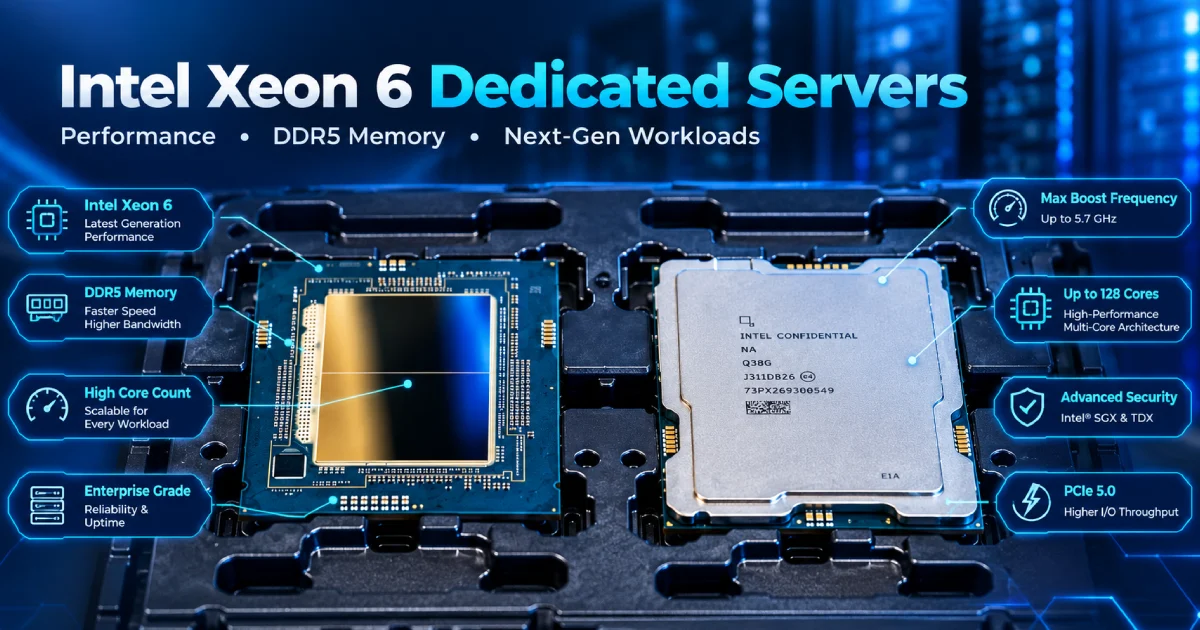
As workloads like Artificial Intelligence (AI), cloud-native applications, and large in-memory databases continue to grow, the demands placed on server infrastructure have never been higher. To meet these intensive computing challenges, Intel Xeon 6 processors represent a massive leap forward from the previous 5th Gen Intel Xeon Scalable platforms.
For businesses relying on dedicated server hosting, raw compute power alone is no longer enough. Modern data centers require efficiency, maximum scalability, and, most importantly, lightning-fast data transfer to prevent bottlenecks.
Intel Xeon 6 delivers exactly this by introducing two distinct processor architectures:
- Performance-cores (P-cores): Designed for raw speed and complex enterprise workloads.
- Efficient-cores (E-cores): Built for maximum compute density and power savings.
When paired with the expanded capabilities of DDR5 server memory, the Xeon 6 platform provides a strong, future-proof foundation. Whether you are running transaction-heavy enterprise applications, training AI models, or managing high-density virtual machines (VMs), understanding how this new architecture works is critical to maximizing your server's performance and lowering your Total Cost of Ownership (TCO).
Understanding the Architecture: E-Cores vs. P-Cores
Unlike previous generations, Intel Xeon 6 processors are split into two distinct series, allowing server architects to choose the exact processing power that matches their specific workload needs. This dual-architecture approach provides the flexibility to prioritize either extreme density or maximum per-core performance.
Efficient-cores (E-cores): Best for Cloud-Native & High-Density
The E-core processors (Sierra Forest-SP) are built primarily for cloud-native and scale-out workloads where rack density and power efficiency are the top priorities.
For data centers and hosting providers, E-cores allow you to run significantly more instances and virtual machines per server rack while keeping energy consumption strictly under control. In fact, Intel’s data shows that Xeon 6 with E-cores delivers an impressive 3:1 rack consolidation compared to older 2nd Gen Intel Xeon processors. This makes it the ideal choice for companies looking to lower their Total Cost of Ownership (TCO) without sacrificing everyday operational stability.
Performance-cores (P-cores): Built for AI, Databases, and Low Latency
On the other hand, the P-core processors (Granite Rapids) are engineered for traditional, heavy-duty enterprise applications that demand consistent speed and responsiveness.
P-cores deliver higher per-core performance, making them the perfect match for transaction-heavy systems, real-time analytics, and large databases where predictable, low latency is required. Furthermore, they support more memory channels, delivering the massive bandwidth needed to drive complex workloads like in-memory datasets and Artificial Intelligence. When paired with advanced MRDIMMs, Xeon 6 with P-cores delivers up to 5.5x better AI inferencing performance compared to AMD EPYC processors.
The 2DPC Memory Breakthrough: Why 6000 MT/s Matters
When architecting a high-performance dedicated server, memory speed is just as critical as raw CPU power. It dictates the total data throughput available to your processors and prevents costly data bottlenecks in modern server environments.
Typically, populating servers with more memory modules increases electrical load and forces the system to drop to slower memory speeds. However, Intel Xeon 6 processors with P-cores deliver a unique advantage using a 2 DIMM per channel (2DPC) configuration. This setup allows data centers to achieve maximum RAM capacity without sacrificing CPU performance, offering the largest x86 dual-socket memory capacity currently available from mainstream OEMs.
Breaking the Speed Barrier Intel has pushed the boundaries of DDR5 server memory by enabling 2DPC memory speeds of 6000 MT/s on the Xeon 6700 and 6500P processors. To put this into perspective, competing platforms like AMD EPYC are currently limited to 4400 MT/s in similar high-density configurations. This massive bandwidth advantage is exclusive to Intel, allowing you to optimize for cost, capacity, and performance simultaneously.
The real-world performance gains are substantial:
- 25% better average performance compared to 5th Gen Intel Xeon processors at equal core counts.
- 2.18x performance improvement in heavy media transcode workloads (like SVT-AV1) when using 2DPC at 6000 MT/s compared to a 1DPC setup at 6400 MT/s.
Zero Hardware Changes Required One of the most impressive engineering feats of this generation is the robust design of the Intel memory controller. If you are already running populated memory in an Intel Xeon 6 P-core system at 5200 MT/s, you can unlock the full 6000 MT/s speed via a simple software update. Absolutely no physical hardware changes or expensive memory replacements are required.
4 Operational Benefits of Upgrading to Xeon 6 Dedicated Servers
Upgrading your infrastructure to Intel Xeon 6 dedicated servers isn't just about raw speed; it translates directly into better stability, higher revenue potential, and reduced operational costs. Here are the four major operational advantages of leveraging high-speed 2DPC memory configurations:
1. Prevents Core Starvation and Accelerates Databases
As modern server chips increase in core counts, keeping those cores constantly fed with instructions is a challenge. Faster 2DPC DDR5 memory speeds prevent "core starvation," ensuring your expensive CPU infrastructure doesn't sit idle in wait-states. This is especially critical for enterprise applications like SAP HANA, Redis, and SQL clusters, which load entire multi-terabyte datasets directly into the server's RAM for real-time processing and transaction execution without data bottlenecks.
2. Maximizes Virtual Machine (VM) Density
Data centers rely on 2DPC configurations to pack massive RAM capacities into virtualized environments. With the higher bandwidth access provided by Xeon 6, hosting providers can pack more revenue-generating VMs onto a single physical dedicated server. You achieve higher consolidation ratios without ever sacrificing the performance your clients expect.
3. Isolates "Noisy Neighbors" in Multi-Tenant Environments
In public cloud and multi-tenant environments, multiple clients share the same physical hardware. If one client runs a highly data-intensive application on a slow memory system, they can easily saturate the memory bus and slow down adjacent workloads. The higher 6000 MT/s clock speeds of Intel Xeon 6 provide enough bandwidth headroom to buffer tenants from each other's data spikes, effectively eliminating the "noisy neighbor" problem.
4. Lowers Total Cost of Ownership (TCO)
Efficiency directly impacts your bottom line. Faster memory speeds mean the server finishes tasks quicker, allowing it to return to power-saving idle states or reallocate cores to other critical tasks. This reduces the time the server draws peak power, driving down both electricity and cooling costs. At typical 40% server utilization, an Intel Xeon 6 processor with P-cores delivers a massive 1.9x better performance-per-watt compared to the previous 5th Gen Intel Xeon.
Advanced Server Memory Configurations: DDR5 & MRDIMMs
To achieve the massive performance leaps seen in the Intel Xeon 6 architecture, Intel has completely phased out older DDR4 platforms. Xeon 6 is purpose-built exclusively for DDR5 server memory, delivering unmatched capacity, data integrity, and power efficiency.
Depending on your dedicated server configuration, Xeon 6 supports a variety of advanced memory modules to suit different enterprise needs:
- RDIMMs (Registered DIMMs): The most widely adopted option, striking the perfect balance between cost and performance for standard enterprise workloads (supporting speeds up to 6400 MT/s).
- MRDIMMs (Multiplexed Rank DIMMs): Designed for extreme density and high-performance environments. These modules push bandwidth limits, reaching up to 8800 MT/s on the Xeon 6900-series and 8000 MT/s on the 6700/6500-series platforms.
- 3DS RDIMMs: Built for ultimate capacity, delivering up to 256GB per module. These are critical for hosting massive in-memory databases and advanced analytics.
Enterprise-Grade RAS Features for Maximum Uptime
For businesses utilizing dedicated server hosting, hardware reliability and continuous uptime are non-negotiable. Intel Xeon 6 platforms are equipped with advanced Reliability, Availability, and Serviceability (RAS) safeguards that protect critical workloads:
- Single Device Data Correction (SDDC): The memory controller actively detects and corrects errors at the device level to prevent data corruption.
- Post Package Repair: Automatically repairs both hard (hPPR) and soft (sPPR) bit errors, remapping failing address rows without requiring a system reboot.
- Memory Sparing & Mirroring: Configurable modes that either redirect workloads to spare memory modules during a failure or create live duplicates across DIMMs to ensure seamless redundancy.
- ECC (Error Correction Code): Built-in algorithms for advanced single-bit and multi-bit error detection and correction.
(Pro Tip: To ensure these advanced memory controllers operate at peak efficiency and lowest latency, always keep your server's BIOS and firmware updated.)
Use Cases: Which Workloads Benefit the Most?
Intel Xeon 6 processors are not a one-size-fits-all solution; they offer highly optimized platform options designed to dominate specific enterprise workloads. Whether you prioritize extreme compute density or raw processing power, here is where Xeon 6 dedicated servers truly excel:.
- AI and High-Performance Computing (HPC): Training large Artificial Intelligence models and running complex simulations require immense bandwidth. The Xeon 6900-series (Granite Rapids-AP), featuring a massive 12-channel DDR5 memory architecture, provides the unmatched data throughput required for AI inference and HPC environments.
- Enterprise Databases and Analytics: For SQL servers, heavy transactional environments, and in-memory analytics, the P-core Xeon 6 processors are the perfect match. They ensure predictable, low-latency performance and high throughput for mission-critical data.
- Virtualization and VM Density: Thanks to expanded DDR5 capacity and advanced 2DPC 6000 MT/s configurations, hosting providers can achieve higher VM consolidation ratios. This means running significantly more virtual machines per physical server without encountering memory bottlenecks.
- Cloud and Scale-Out Deployments: For providers managing thousands of lightweight, cloud-native instances, the Xeon 6700E-series (Sierra Forest-SP) delivers unparalleled power efficiency, allowing maximum workload density per server rack.
Conclusion: Future-Proofing Your Infrastructure
The transition to Intel Xeon 6 represents a fundamental shift in how modern data centers operate. With the industry moving away from DDR4, the adoption of blazing-fast DDR5 memory, expanded memory channels, and workload-optimized E-core and P-core architectures provides a massive competitive advantage.
Matching the right Xeon 6 processor and memory configuration to your specific workload ensures you achieve your long-term performance, reliability, and energy-efficiency goals.
Are you ready to meet the extreme demands of AI-driven and data-heavy applications? Explore MIG servers Intel Xeon 6 Dedicated Servers to configure the perfect high-performance server tailored exactly to your enterprise needs.
 Recent Topics for you