MIG servers August 04, 2026
Generative AI is advancing rapidly, and the demand for computational power is pushing data center infrastructure to its limits. For AI factories focused on trillion-parameter Large Language Models (LLMs) and real-time AI reasoning, standard hardware simply isn't enough anymore.
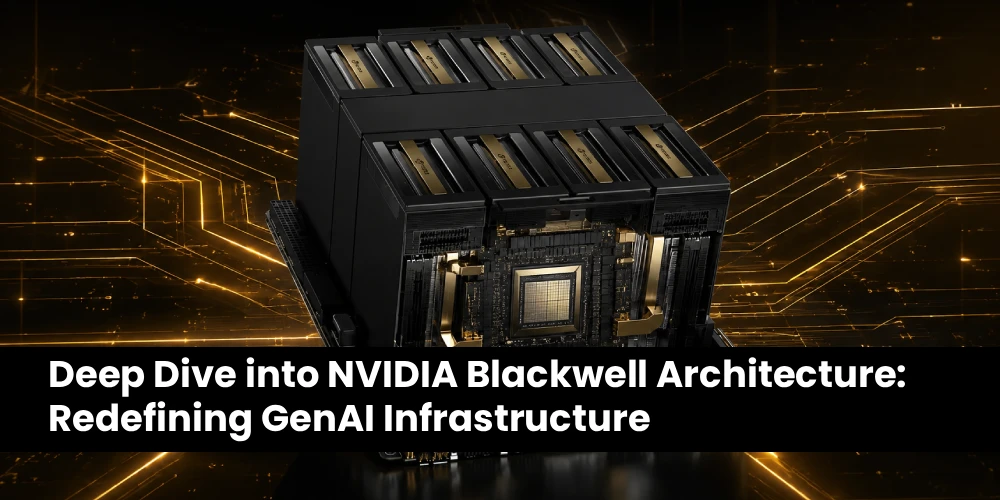
Enter the NVIDIA Blackwell architecture, heralded as the engine of the new industrial revolution.
In modern infrastructure, the weakest link is rarely the compute or memory layer; it is the storage I/O. No matter how incredibly fast your processors are, if your storage drives cannot feed data to the CPU quickly enough, those expensive processor cores simply sit idle, waiting for data (a state known as high I/O wait).
At MIG servers, we specialize in providing high-performance, dedicated server infrastructure. We know that choosing the right hardware is critical for scaling complex AI workloads efficiently. Blackwell represents a monumental leap in accelerated computing, delivering unmatched efficiency, computing density, and scale.
In this guide, we will break down what makes the NVIDIA Blackwell architecture a groundbreaking advancement and how it impacts the future of enterprise AI deployments.
Table of Contents
What is NVIDIA Blackwell?
NVIDIA Blackwell is a next-generation GPU architecture and data center platform purpose-built to handle the most demanding AI and cloud computing workloads. While the market often associates GPUs with graphics rendering, Blackwell is strictly an enterprise-grade system. Unlike consumer gaming GPUs (such as the RTX series), Blackwell is completely optimized for processing massive datasets, complex neural networks, and generative AI systems.
It directly succeeds the highly successful NVIDIA Hopper architecture, bringing a massive leap in compute performance, memory bandwidth, and multi-node scalability to the data center.
At the hardware level, Blackwell represents an entirely new class of AI superchip. To achieve its unprecedented computing density, NVIDIA engineering broke through traditional manufacturing limits.
Here is what makes the silicon so groundbreaking:
- Unmatched Scale: These GPUs pack an astounding 208 billion transistors, providing the raw compute density needed for trillion-parameter models.
- Custom Fabrication: The architecture is manufactured utilizing a custom-built TSMC 4NP process, balancing extreme performance with energy efficiency.
- Unified Architecture: To overcome physical die limits, all Blackwell products feature two reticle-limited dies. Instead of acting as separate processors, they are seamlessly linked by a 10 terabytes per second (TB/s) chip-to-chip interconnect. This allows the dual-die setup to function together flawlessly as a single, unified GPU.
Inside the Technological Breakthroughs
NVIDIA Blackwell is not just a faster chip; it is a fundamental redesign of how computing resources interact. By addressing the specific bottlenecks of large-scale AI operations, Blackwell introduces several industry-first innovations.
Second-Generation Transformer Engine
Training and running Large Language Models (LLMs) and Mixture-of-Experts (MoE) models requires staggering amounts of computational power. To solve this, Blackwell introduces its second-generation Transformer Engine.
This engine pairs custom NVIDIA Tensor Core technology with software innovations like NVIDIA TensorRT™-LLM and the NeMo™ Framework. What truly sets it apart is the introduction of micro-tensor scaling. This fine-grain scaling technique enables 4-bit floating point (FP4) AI precision.
By computing in FP4, Blackwell effectively doubles the performance and memory capacity for next-generation models while maintaining high accuracy. The result is an unprecedented 2X acceleration in the attention layer and 1.5X more AI compute FLOPS compared to previous generations.
5th-Generation NVLink & NVLink Switch
Unlocking the full potential of exascale computing and trillion-parameter AI models hinges on one critical factor: how fast GPUs can talk to each other. Even the fastest GPUs will bottleneck if the network connecting them is slow.
The fifth-generation NVIDIA NVLink interconnect solves this by scaling up to 576 GPUs to unleash accelerated performance.
Within a single 72-GPU NVLink domain (NVL72), the NVIDIA NVLink Switch Chip enables a massive 130TB/s of GPU bandwidth. When expanding to multi-server clusters, NVLink scales communications seamlessly at a 1.8TB/s interconnect speed. This means an NVL72 setup can support 9X the GPU throughput of a standard eight-GPU system, delivering the sheer scale required for enterprise AI.
Secure AI with Confidential Computing
Security is a paramount concern for enterprises dealing with proprietary data and highly sensitive AI intellectual property (IP).
NVIDIA Blackwell is the industry’s first TEE-I/O capable GPU. With strong hardware-based security, NVIDIA Confidential Computing protects your sensitive data and models from unauthorized access. Crucially, this security does not come at the cost of speed—Blackwell delivers nearly identical throughput performance compared to unencrypted modes. This allows enterprises to securely perform AI training, real-time inference, and federated learning without performance degradation.
Decompression Engine & RAS (Reliability for Enterprise)
Beyond pure AI, accelerated data science dramatically boosts the performance of end-to-end analytics. The Blackwell architecture features a dedicated Decompression Engine that accelerates the full pipeline of database queries. Thanks to a high-speed, 900 GB/s bidirectional link to the NVIDIA Grace™ CPU, it supports the latest compression formats like LZ4, Snappy, and Deflate, optimizing workflows for databases like Apache Spark.
Finally, managing a cluster of powerful servers requires maximum uptime. Blackwell adds intelligent resiliency via a dedicated Reliability, Availability, and Serviceability (RAS) Engine. Using AI-powered predictive management, the RAS engine continuously monitors thousands of hardware and software data points. By identifying potential faults early, it localizes issues quickly, minimizes downtime, and drastically reduces maintenance turnaround time—saving both energy and computing costs for data center operators.
Blackwell vs. Hopper: What’s the Real Difference?
The NVIDIA Hopper architecture—powered primarily by the H100 GPU—is a mature, widely adopted, and incredibly powerful foundation for today's mixed AI and high-performance computing (HPC) workloads. However, as the industry pushes toward increasingly complex Generative AI applications, the compute requirements are skyrocketing.
While Hopper handles current demands brilliantly, Blackwell is purpose-built for the massive scale of tomorrow. For AI developers and data center operators dealing with trillion-parameter models, the transition from Hopper H100 to Blackwell B200 is not just an incremental hardware upgrade; it is a fundamental shift in computing density and efficiency.
Here is how the two powerhouse architectures compare:
| Feature | NVIDIA Hopper (H100) | NVIDIA Blackwell (B200) |
|---|---|---|
| Primary Focus | Mixed AI & Traditional HPC Workloads | Massive LLMs & Generative AI at Scale |
| Transformer Engine Precision | 1st Generation (FP8 precision) | 2nd Generation (FP4 micro-tensor scaling) |
| Interconnect Technology | 4th Generation NVLink | 5th Generation NVLink (Scales up to 576 GPUs) |
| NVLink Domain Bandwidth | Scalable for standard multi-GPU clusters | 130 TB/s (within a single 72-GPU NVL72 domain) |
| Security via Confidential Computing | Standard hardware security features | 1st TEE-I/O capable GPU with zero performance loss |
For enterprise decision-makers, the takeaway is clear: If your workloads involve standard machine learning or mixed HPC tasks, Hopper remains a formidable choice. But if you are building the next generation of AI reasoning engines or serving complex LLMs to millions of users, the Blackwell B200 offers the advanced interconnects and memory bandwidth required to prevent bottlenecks.
Benefits and Infrastructure Considerations
When evaluating next-generation hardware for enterprise AI, it is critical to look beyond the marketing benchmarks and understand the real-world deployment realities. The NVIDIA Blackwell architecture delivers unmatched performance, but it also demands a complete rethink of data center physics.
Here is an honest look at the benefits, the physical constraints, and how to navigate them.
The Clear Benefits for AI Workloads
For organizations pushing the boundaries of machine learning, Blackwell's advantages are transformative:
- Massive Compute Throughput & HBM3e Memory: With support for ultra-fast HBM3e memory delivering multi-terabyte-per-second bandwidth, Blackwell GPUs can handle significantly larger models, bigger batch sizes, and longer context windows without being bottlenecked by slower system memory.
- Energy Efficiency per Output: While the chip itself draws significant power, the efficiency per AI output (such as the cost per token during LLM inference) is drastically improved. You get more computational work done per watt than ever before.
- Flexible Resource Sharing via MIG: The architecture fully supports advanced virtualisation features like Multi-Instance GPU (MIG). This allows a single massive Blackwell GPU to be partitioned into smaller, fully isolated instances, ensuring optimal resource utilisation across multiple, smaller workloads.
The Infrastructure Reality Check
While the performance gains are undeniable, deploying Blackwell in-house introduces severe infrastructure challenges. These are not plug-and-play GPUs:
- Extreme Power Draw: A single Blackwell GPU can consume up to ~1,000 watts. Pushing a full cluster of these chips strains the electrical limits of standard data center facilities.
- Mandatory Liquid Cooling: Traditional air-cooling systems are simply incapable of dissipating the heat generated by the B200. Liquid cooling infrastructure is no longer optional; it is a strict requirement to maintain system stability and prevent thermal throttling.
- Incompatible with Standard Racks: You cannot slot a Blackwell GPU into a legacy server chassis. These chips require purpose-built AI systems, such as NVIDIA HGX or DGX platforms, which demand specialized physical footprints and advanced network topologies.
Key Use Cases for Blackwell GPUs
NVIDIA Blackwell is not a general-purpose processor; it is an architecture built to solve specific, massive-scale computational problems. By matching its hardware innovations to modern software demands, Blackwell unlocks new capabilities across several critical enterprise domains.
Here are the primary workloads where the Blackwell architecture delivers the most value:
1. LLM Training and Fine-Tuning
Training trillion-parameter Large Language Models (LLMs) requires moving petabytes of data continuously through complex neural networks. Blackwell is highly optimized for extreme-scale training. The second-generation Transformer Engine, utilizing micro-tensor scaling and FP4 precision, drastically speeds up model training cycles. For AI engineering teams, this means the ability to complete the training of complex AI architectures significantly faster, accelerating the time-to-market for proprietary models.
2. Large-Scale Inference and LLM Serving
As AI moves from research into production, running these models to serve real users—known as inference—becomes the most resource-intensive part of the AI lifecycle. Blackwell excels at large-scale inference by delivering massive throughput capabilities. It handles high token throughput efficiently, ensuring fluid, low-latency interactions for demanding applications like intelligent virtual assistants and real-time AI chatbots. Ultimately, this architecture drives down the infrastructure cost per token, making enterprise-scale AI deployments financially sustainable.
3. Big Data Analytics and HPC
Beyond generative AI, Blackwell accelerates traditional High-Performance Computing (HPC) and massive data analytics workflows. With its dedicated Decompression Engine and ultra-fast data links, it can rapidly process and extract insights from massive datasets. This enables organizations to blend traditional computing simulations with machine learning models seamlessly, driving innovation in fields ranging from climate modeling to energy research.
4. Physical AI and Robotics
The future of AI is not just software; it is physical. Blackwell plays a pivotal role in the development of Physical AI—intelligent systems embedded in real-world machines, autonomous systems, and smart factories. The architecture supports the entire robotics pipeline:
- Training complex vision and action models at scale in the data center.
- Running high-fidelity Digital Twin simulations to safely test autonomous logic before real-world deployment.
- Providing the foundational architecture for edge devices (like the Jetson Thor) that run low-latency, real-time embedded AI directly on the robot.
Conclusion: The Future of Dedicated AI Servers
The NVIDIA Blackwell architecture has definitively set the new standard for accelerated computing. By fundamentally redesigning how data flows across chips and scaling compute density to unprecedented levels, it serves as the ultimate foundation for modern AI data centers. Whether you are training trillion-parameter LLMs, running real-time generative AI inference, or pioneering physical AI, Blackwell is built to handle the future of computing.
However, as we have explored, unlocking this massive potential comes with severe physical constraints. Managing 1,000W processors, deploying mandatory liquid cooling infrastructure, and accommodating specialized server architectures represent massive logistical and financial hurdles. For most organizations, attempting to build and maintain this level of infrastructure in-house is incredibly risky and capital-intensive.
This is exactly why renting a dedicated server is the smartest financial and operational move. It allows your data scientists and AI engineers to focus purely on innovation and model deployment, rather than wrestling with thermal throttling and power grid limitations.
At MIG servers, we absorb these infrastructure complexities for you. We are proud to provide next-generation infrastructure, bringing NVIDIA Blackwell GPUs to our bare-metal fleet so you can access industry-leading compute power without the massive upfront investment.
 Recent Topics for you